
- Home
- Suite features
The Regingada Compliance Suite, one module per page
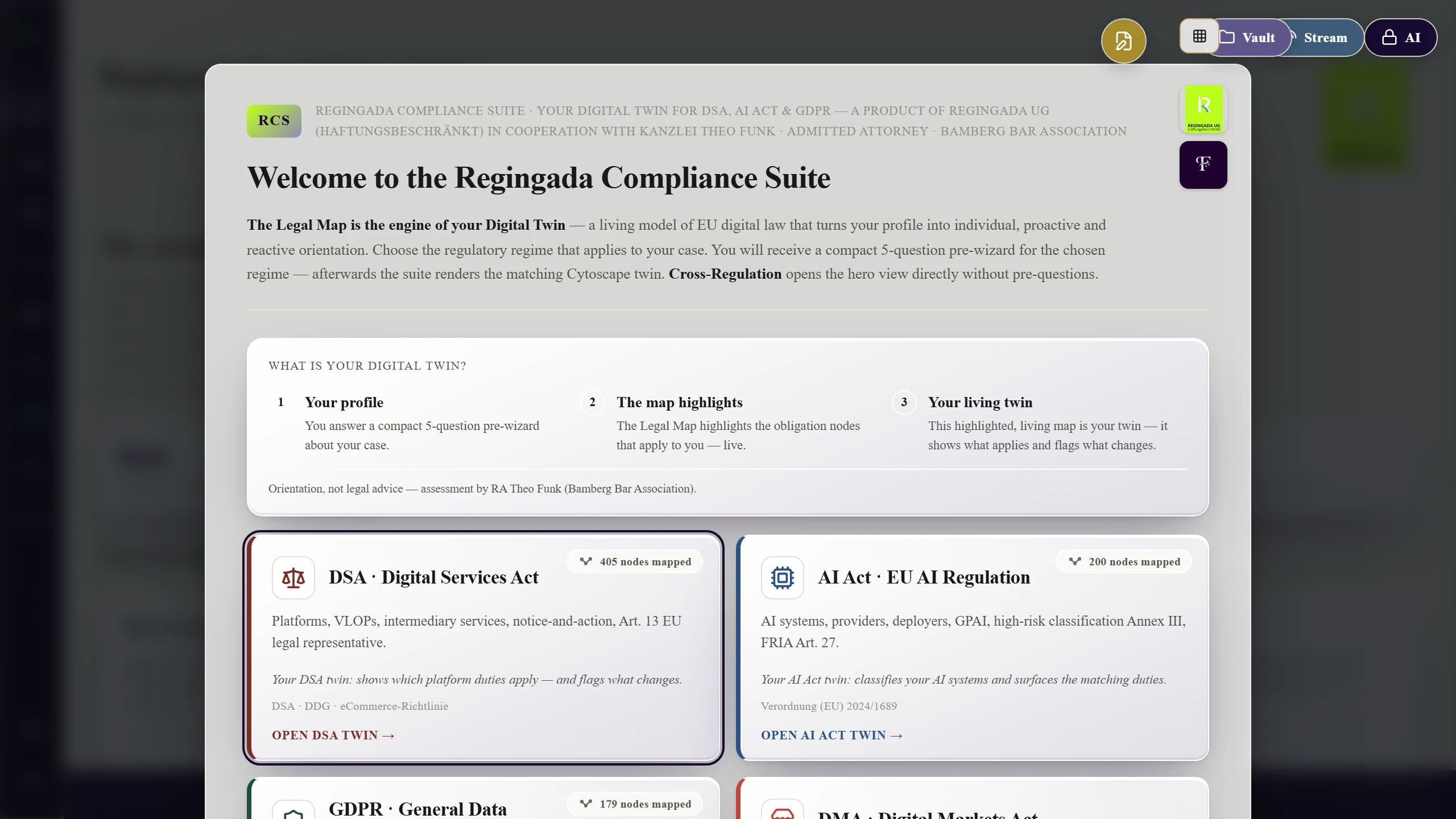
The Regingada Compliance Suite is EU compliance software for companies outside the EU: a legal map of 963 nodes for the DSA, the AI Act, the GDPR and China's PIPL, quick checks for three regimes and obligation cockpits for seven. Each module has its own page below — what it does, which articles it covers, and where it stops.
- 963 nodes · 1,928 relations
- 7 regime cockpits
- 119 cross-regime links · 68 classified collisions
- legal advice · not in the software
What can EU compliance software do for a company outside the EU?
It can sort the facts EU digital law turns on — your role, your establishment, what your service does — and point to the provisions and obligations they trigger. The reach is set by statute: the AI Act applies when AI systems or general-purpose AI models are placed on the EU market or an AI system's output is used there (Art. 2(1)(a) and (c) AI Act); the GDPR when goods or services are offered to people in the Union or their behaviour there is monitored (Art. 3(2) GDPR); the DSA when intermediary services are offered in the Union with a substantial connection to it (Art. 2(1), Art. 3(d)–(e) DSA).
The suite indicates the duties; it does not decide them. Cockpits and the applicability statement follow fixed rules, so the same answers give the same list — the opt-in AI assistant is the exception, a language model whose answers you check. Whether a duty applies to your facts is a legal question for counsel.
Eight platform modules, and how far each one reaches
The shared parts of the EU digital law compliance tool. None spans all seven regimes; each card says where it stops.
- Legal Map
EU digital law map
963 nodes — provisions, recitals, definitions and court decisions of the DSA, the AI Act, the GDPR and PIPL, plus German national law — with curated summaries and a source link on almost every node. Summaries, not full statutory text.
- Quick check
Structured self-assessment
Three to five questions each for the DSA, the AI Act and the GDPR build your profile; the DMA, NIS2, the Data Act and PIPL are scoped through entries in their cockpits.
- Obligation cockpits
Obligations register
Per regime, only the duties your profile triggers, with article and task list — tickable in the AI Act and GDPR cockpits — plus a cross-regime applicability statement to download.
- Cross-Regulation Mode
Cross-regulation mapping
Where one measure bears on several regimes (the duties stay cumulative), and where two collide: guided tours, an article matrix and a collision resolver that classifies 68 collisions at corpus level — not an assessment of your case.
- Deliverables
Deliverables and exports
What the browser edition downloads — an applicability statement (HTML, CSV), an orientation pack (HTML, JSON), cockpit records (JSON) — none of it an opinion. DOCX reports are not part of the browser edition.
- Mandate Mark
Mandate Mark
A verifier for signed representation credentials under Art. 13 DSA and Art. 54 AI Act, checked in your browser. It runs with demonstration credentials only; credentials for live appointments are not issued yet.
- AI assistant
AI assistant
An opt-in chat for general questions on the DSA, the AI Act and the GDPR, unlocked by an access code. It is instructed to give general orientation only; its article references are model output to check on the map.
- Horizon Scanner
Deadlines and horizon
Twelve curated milestones, January 2025 to March 2029, with countdowns — a static list, not an alert service.
One cockpit per regime, one page per cockpit
The suite works as compliance software for the AI Act, the GDPR, the DSA and NIS2 as well as for the DMA, the Data Act and PIPL; each cockpit page says what it covers and what it leaves out.
| Regime | Feature pages | Representative duty |
|---|---|---|
| AI Act | AI Act cockpit · risk classification · Annex IV documentation · timeline after the Omnibus | Art. 54 (GPAI) service page |
| GDPR | GDPR cockpit · DPIA tool | Art. 27 service page |
| DSA | Digital Services Act cockpit · systemic risk assessment | Art. 13 service page |
| DMA | Digital Markets Act cockpit | no appointment duty in the DMA |
| NIS2 | NIS2 cockpit · incident reporting | Art. 26(3) service page |
| Data Act | Data Act cockpit | Art. 37(11) service page |
| PIPL (China) | PIPL transfer check | Art. 53 PIPL · a representative in China, outside this service |
For the high-risk AI systems of Art. 22 AI Act, the authorised-representative duty applies only from 2 December 2027 (Annex III) and 2 August 2028 (Annex I) under Regulation (EU) 2026/1744; for general-purpose AI models under Art. 54 it has applied since 2 August 2025.
From the first question to counsel
- Map. Open the suite, confirm the legal notice and pick a regime. For the DSA, the AI Act and the GDPR a quick check builds your profile and the map marks what it touches; the other four regimes start from entries in their cockpits.
- List. The cockpit lists the obligations your profile triggers, with their tasks, and Client Workflow offers an applicability statement across all seven registers.
- Export. The orientation pack lists your answers, 'Unsure' included; the statement marks rows that turn on an open answer as 'unclear'. Both are working papers.
- Appoint, where the law asks for it. Companies without an EU establishment may owe an EU representative under several regimes. Regingada UG can take on that role under its own contract — see the representation overview or EU representation for US companies.
- Decide with counsel. Whether a duty applies to your facts, and how to meet it, is legal advice. The law firm Theo Funk can give it under a separate mandate — two contracts, billed separately, neither requiring the other.
Start from the question you already have
- Is our AI system high-risk?Start with the AI Act risk classification, then the timeline to see when the duties apply.
- Do we need a DPIA?Once your GDPR entries trigger it, the DPIA cockpit screens against Art. 35(3) GDPR and the nine criteria of the WP29 guidelines (WP248 rev.01). The decision stays with the controller.
- A security incident just happenedOnce your NIS2 entity is in scope, the NIS2 incident register counts down the 24-hour and 72-hour stages and sets a 30-day internal target for the final report.
- Which dates are coming?The deadline timeline collects curated milestones from 2025 to 2029 across regimes.
- What does this cost us in effort?The separate EU exposure estimate gives a range for the coordination load of your footprint.
Frequently asked questions
What is the Regingada Compliance Suite?
It is EU regulatory compliance software that runs in your browser, for six EU digital-law regimes — the AI Act, the GDPR, the Digital Services Act, the Digital Markets Act, NIS2 and the Data Act — and China's PIPL. Quick checks and cockpit entries build a profile; the suite lists the obligations it triggers and lets you download working files. It is structured self-assessment, not legal advice.
Is the suite legal advice?
No. Regingada UG (haftungsbeschränkt) builds the software and holds appointed EU-representative roles; it is not a law firm and gives no legal advice under the German Legal Services Act (RDG). Results are orientation, downloads are working papers. Legal assessment is available from the law firm Theo Funk under a separate mandate — see theofunklaw.com.
Do I need an account, and where are my answers stored?
No account is needed. Quick-check answers, portfolios and task ticks stay in your browser's local storage, and 'Delete profile' in the settings removes them. Data leaves the browser only on your action: a question to the AI assistant, a form or email you send, a credential ID you check in the Mandate Mark verifier. The Trust Center describes the data paths.
Which EU regulations does the suite cover?
Six EU acts and one Chinese law. The DSA, the AI Act, the GDPR and China's PIPL are mapped to article level in a 963-node legal graph; the DMA, NIS2 and the Data Act have no graph nodes and work as cockpits with their own obligation registers. The Cyber Resilience Act and DORA appear only as dated milestones on the timeline.
Does the suite tell us whether we need an EU representative?
It points to it. When you declare no EU establishment, the DSA, GDPR, Data Act and AI Act cockpits show a representative item — Art. 13 DSA, Art. 27 GDPR, Art. 37(11) Data Act, Art. 54 AI Act for general-purpose AI models — while an 'Unsure' establishment answer hides it. Whether the duty binds you, or an exemption such as Art. 27(2) GDPR fits, the law firm Theo Funk can assess under a separate mandate. Regingada UG can hold the role under its own contract.
What does the suite cost?
The software plans and the status of each are described on the homepage; the fees for the appointed EU-representative service are in the separate price list. Legal advice is never part of a software plan; the law firm bills it under its own mandate.
Open the suite, then decide what needs a lawyer
The suite runs in your browser and needs no account: answer one quick check and read what your profile triggers. When a result matters — a classification you want to rely on, a filing, a letter from an authority — the law firm Theo Funk can assess it under a separate mandate. If it points to an appointment duty, the representation overview explains how Regingada UG takes on that role.