
- Home
- Suite features
- EU digital law map
A map of EU digital law, 963 nodes deep
The EU digital law map in the Regingada Compliance Suite gives teams outside the EU one graph of 963 curated nodes — Digital Services Act (DSA), AI Act, GDPR and PIPL provisions and recitals, German national law and EU Court of Justice (CJEU) judgments — joined by 1,928 typed links. Each node opens a summary, source and connections, not the statutory text.
- DSA · 394 nodes
- AI Act · 199 nodes
- GDPR · 164 nodes
- PIPL · 139 nodes
- DMA · NIS2 · Data Act · no nodes
Is there an EU digital law map that shows how the rules connect?
For four regimes, in part. The map holds every DSA article but a selection of the rest — about half of the AI Act's 113 articles, a third of the GDPR's 99 — plus chosen recitals (the numbered reasons preceding an act's articles) and PIPL provisions, joined by 27 kinds of relation. The DMA, NIS2 and the Data Act are absent.
The difficulty is that the acts point at each other: Article 6 AI Act only makes sense with Annexes I and III, and for some deployers the fundamental-rights impact assessment under Article 27 AI Act will complement the data protection one under Article 35 GDPR (Art. 27(4) AI Act). A DSA, AI Act and GDPR articles database answers what Article X says, not what else moves when it applies.
That second question is what an EU regulatory map is for. Under the surface it is an EU legal knowledge graph: every node is a provision, recital, definition, service type or judgment, and every edge names its relation. It indicates where to read, not what the reading means for your product.
From the first click to the graph
Open /suite/#ai-act. Then:
- Confirm the legal notice. First visit only: tick the box and choose 'Accept & Continue'.
- Choose the AI Act card. It opens the AI Act twin, the suite's workspace for one regulation (how a twin works); the DSA and GDPR cards open theirs.
- Answer the quick check. Role, establishment, AI systems. 'Unsure' works for the first two; the third needs at least one ticked box and has no 'none' option. The twin opens only once the check is saved; closing it returns you to Home.
- Switch from 'Form' to 'Graph'. 'Split' shows cockpit and map side by side.
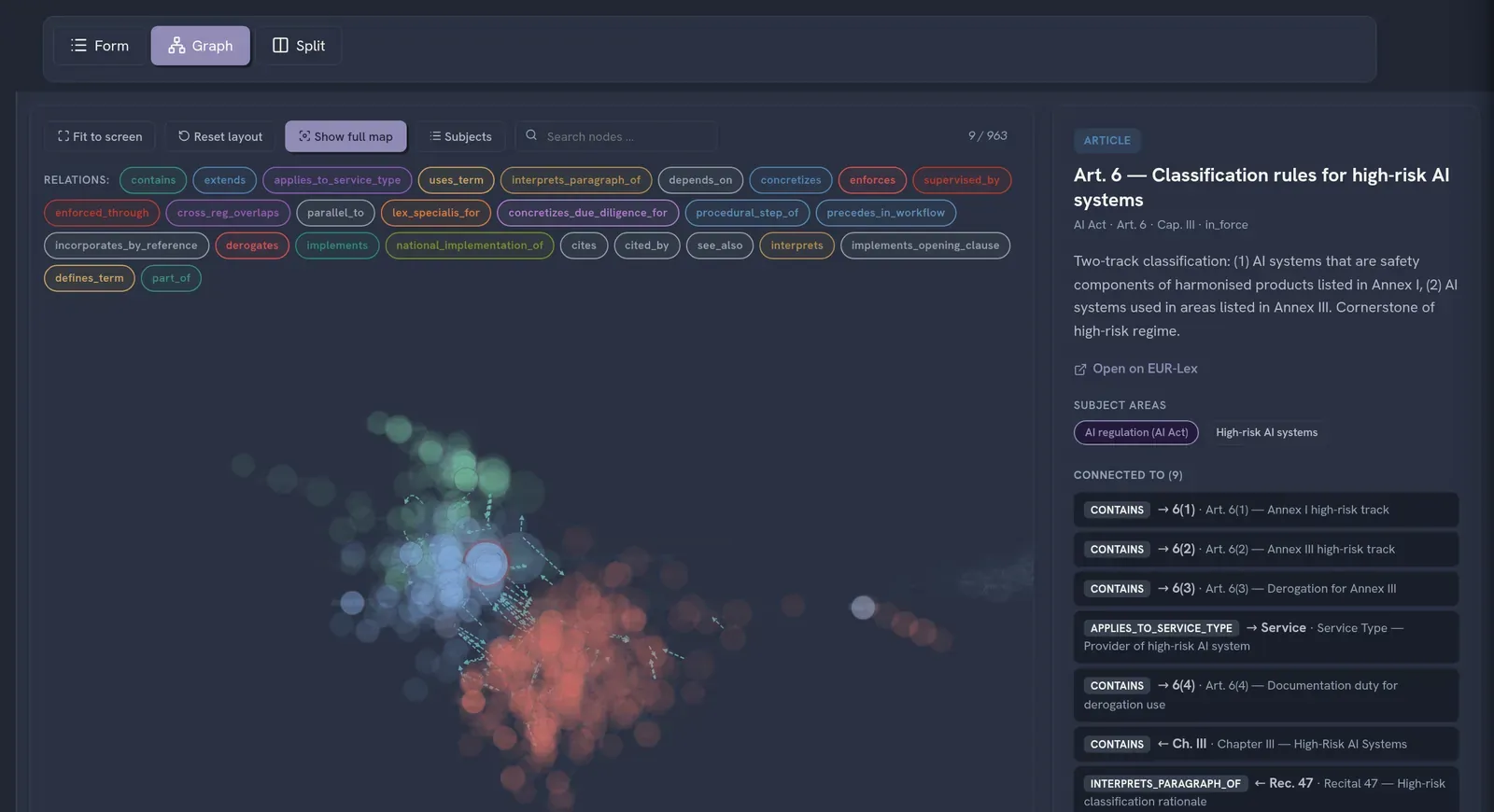
- Read the panel, then widen the view. Graph opens in focus view on Art. 6 AI Act and its direct neighbours, panel open; 'Show full map' lifts the focus. The toolbar adds 'Search nodes …', a 'Subjects' filter and relation pills.
⌘K or Ctrl+K opens a palette that searches all 963 nodes, summaries included: how Cmd-K search works.
What each node and edge tells you
As an EU regulation mapping tool, the map layers three views over the corpus.
| Capability | Scope | Output |
|---|---|---|
| Twin filter | DSA twin: DSA, DDG, e-Commerce Directive · AI Act twin: AI Act · GDPR twin: GDPR, BDSG, BetrVG, AGG | 406, 199 or 179 nodes in colour; the rest, and every edge touching them, faded |
| Node panel | Any node | Summary in the interface language (EN, DE or ZH), source link, subject chips, 'Connected to' list |
| Profile footprint | Quick-check answers mapped to AI Act, DSA and GDPR nodes | Highlighted nodes; a badge counting the twin's nodes your answers touch |
Relations with names
27 edge types, from 'contains' (677 edges) to 'interprets'. Each pill fades one type; there is no 'show only', so isolating interpretation means switching the others off.
Case law beside the article
Thirty CJEU case nodes (16 in the GDPR cluster, 14 mostly on intermediary liability and defence rights) plus German constitutional, labour and civil court decisions.
A source for nearly every node
946 of 963 nodes carry a source link, 750 of them to EUR-Lex; most others go to Chinese, German and CJEU sites. The 17 without one are AI Act recitals.
Three languages
Every node has an English, German and Chinese summary; the English and German PIPL texts are non-official working translations. See the PIPL transfer module and the EU–China sector profile.
A CV-ranking vendor, traced through the graph
Take a hypothetical US HR-software vendor without an EU office, selling a CV-ranking feature to employers in Germany and France. None of the high-risk provisions below applies yet: Regulation (EU) 2026/1744 moved Chapter III, Sections 1 to 3, of the AI Act to 2 December 2027 (Annex III) and 2 August 2028 (Annex I), whatever the node panel shows.
- Quick checkProvider, established outside the EU, Annex III high-risk area. By our reading, the badge then shows 23 of 199 AI Act nodes touched — open the suite and reconcile.
- Art. 6Its panel lists 6(1) to 6(4), Recital 47, Art. 99 on penalties and the service type 'Provider of high-risk AI system'.
- Annex III 4(a)Reached through Art. 6(2) under 'Connected to', and highlighted. Its connections include the SCHUFA judgment (C-634/21), a credit-scoring case linked here by analogy, which the graph also ties to Art. 22 GDPR on automated decisions.
- Art. 27 AI ActHighlighted too once you click 'Show full map', although the fundamental-rights impact assessment binds deployers, not providers, and only some: bodies governed by public law, private entities providing public services and deployers of credit-scoring or life- and health-insurance pricing systems (Art. 27(1) AI Act). A private employer buying the feature is usually outside it. Its links to Art. 35 and Art. 22 GDPR are listed under 'Connected to' but drawn faded; the collision map sets out that seam.
- Art. 6(3)The derogation node notes that an Annex III system profiling natural persons is always high-risk. Whether the feature profiles applicants, the map leaves open.
What this map of EU digital regulations leaves out
- No statutory text: summaries average about 370 characters.
- Coverage is curated: Art. 3 GDPR (territorial scope), Arts 44–49 GDPR (third-country transfers) and Art. 2 AI Act (scope) have no node.
- German law is the only national law in the graph; French employment law, for one, is absent.
- Source links open the whole act or judgment, never the article, and read 'Open on EUR-Lex' even for npc.gov.cn or gesetze-im-internet.de.
- 179 nodes, among them all PIPL nodes and 14 CJEU judgments, sit outside every twin filter and always appear faded on the desktop graph, though not in the phone list.
- The footprint is a union of answers, not a finding: 'Established outside the EU' highlights both AI Act representative articles, Art. 54 on general-purpose AI models included, whatever you build.
- Every AI Act node shows 'in_force': a status of the act, not the date an obligation applies.
- No export, and no link to a node: the address carries the twin only. A packaged read-only corpus of 824 nodes is built for an API and an MCP server: corpus API and MCP status.
- Relation pills show raw keys; the panel's AI button stays disabled until the AI assistant is unlocked with an access code.
Frequently asked questions
Which regulations are in the graph, and which are not?
Four carry the weight: the DSA (394 nodes), the AI Act (199), the GDPR (164) and China's PIPL with its CAC transfer rules (139). German law adds its DSA implementing act (DDG), data protection act (BDSG), works council and equal treatment acts (BetrVG, AGG) and the Basic Law; 17 further EU instruments appear as single nodes or small clusters. The DMA, NIS2 and the Data Act have cockpits but no nodes.
Can I search for a specific article, recital or CJEU case?
Yes, with two catches. 'Search nodes …' matches node ID, English and German title, regulation, number and tags, but only within the current focus and twin. Click 'Show full map' first and search in the twin that holds the node: 'C-634/21' finds the SCHUFA judgment in the GDPR twin. CELEX numbers are not searchable.
How current is the corpus?
One date covers the whole corpus: the suite's legal notice currently reads 'Law as of June 11, 2026'. There is no review date per provision, and the AI Act dates stored in the graph do not reflect Regulation (EU) 2026/1744; check them on the AI Act timeline.
Do I need an account to use the map?
No. There is no account or login. You accept the legal notice once; quick-check answers, view mode and footprint setting stay in your browser's local storage until you clear it. What leaves the browser, and when, is set out in the Trust Center.
Can I use the map on a phone?
Yes, as a list. At 768 pixels wide or less the suite adds 'Search articles, recitals, cases …' and lists 80 nodes at a time; tapping a row opens the node details as a bottom sheet, and 'Open graph' shows the full canvas.
A map of the provisions, not a reading of them
The EU digital law map shows which curated provisions sit around your answers. It cannot tell you whether SCHUFA's reasoning on credit scores reaches a CV ranking, whether a 370-character summary drops the sentence that decides your case, or which French employment rules bind a customer in Lyon. The law firm Theo Funk can assess that under a separate mandate.
One strand is operational. A company without an EU establishment may have to designate a representative in the Union: under Art. 27 GDPR, Art. 13 DSA or, for general-purpose AI models, Art. 54 AI Act. For providers of high-risk AI systems, Art. 22 AI Act applies from 2 December 2027 (Annex III) and 2 August 2028 (Annex I) under Regulation (EU) 2026/1744. The footprint does not decide whether a duty applies. Regingada UG (haftungsbeschränkt) can be appointed to the role under its own contract and gives no legal advice — see EU representative for US companies.