
- Home
- Suite features
- AI Act timeline
The EU AI Act timeline after Regulation (EU) 2026/1744
The EU AI Act timeline after Regulation (EU) 2026/1744: prohibitions and AI literacy since 2 February 2025, general-purpose AI (GPAI) model rules since 2 August 2025, Article 50 transparency since 2 August 2026, new prohibitions from 2 December 2026, high-risk systems from 2 December 2027 (Annex III) and 2 August 2028 (Annex I). The suite's Roadmap shows the phases; it does not compute per-system deadlines.
- Regulation (EU) 2026/1744
- Horizon Scanner · AI Act filter
- Per-system deadlines · not computed
- Calendar export · none
What does the EU AI Act timeline look like now?
Staged under Art. 113, and since 27 July 2026 partly moved: Regulation (EU) 2026/1744 — the EU AI Act Digital Omnibus — postponed the high-risk core and added two prohibitions; the other dates held, save one Art. 50 transition. Many pages still give August 2026 for the high-risk rules — sixteen months too early for a US release plan. The EU AI Act deadlines of 2026, 2027 and beyond:
| Date | What applies | Legal basis |
|---|---|---|
| 2 February 2025 | Prohibited practices; AI literacy | Art. 5, Art. 4 · Art. 113(a) |
| 2 August 2025 | GPAI provider obligations, including the written mandate of non-EU providers (Art. 54) | Art. 53 to 55 · Art. 113(b) |
| 2 August 2026 | General application date: transparency for chatbots, synthetic content, deepfakes; Commission fines on GPAI providers | Art. 50, Art. 101 · Art. 113 |
| 2 December 2026 | New prohibitions concerning AI generation of non-consensual intimate imagery and child sexual abuse material; Art. 50(2) marking for generative systems placed on the market before 2 August 2026 | Art. 5(1), Art. 50(2) · Regulation (EU) 2026/1744 |
| 2 August 2027 | GPAI models placed on the market before 2 August 2025 must comply | Art. 111(3) |
| 2 December 2027 | Annex III high-risk systems (listed uses such as hiring or credit scoring): classification, requirements, duties of providers and deployers (businesses using it) | Art. 6(2) + Annex III · Chapter III, Sections 1 to 3 · Regulation (EU) 2026/1744 |
| 2 August 2028 | High-risk AI in Annex I products subject to third-party conformity assessment, such as medical devices | Art. 6(1) + Annex I · Regulation (EU) 2026/1744 |
Before relying on a date, check it against Regulation (EU) 2026/1744 on EUR-Lex.
Data Act, Cyber Resilience Act, DORA and NIS2 dates: EU regulatory deadlines.
From the first click to the Roadmap
Start at /suite/#ai-act:
- Accept the legal notice. Shown once; it gives the suite's law as of 11 June 2026, before the amendment's publication.
- Choose the AI Act card (‘Open AI Act twin →’) on the welcome screen.
- Answer and save the quick check. Role, EU establishment, and which of twelve system types apply; closing it instead returns you to Home.
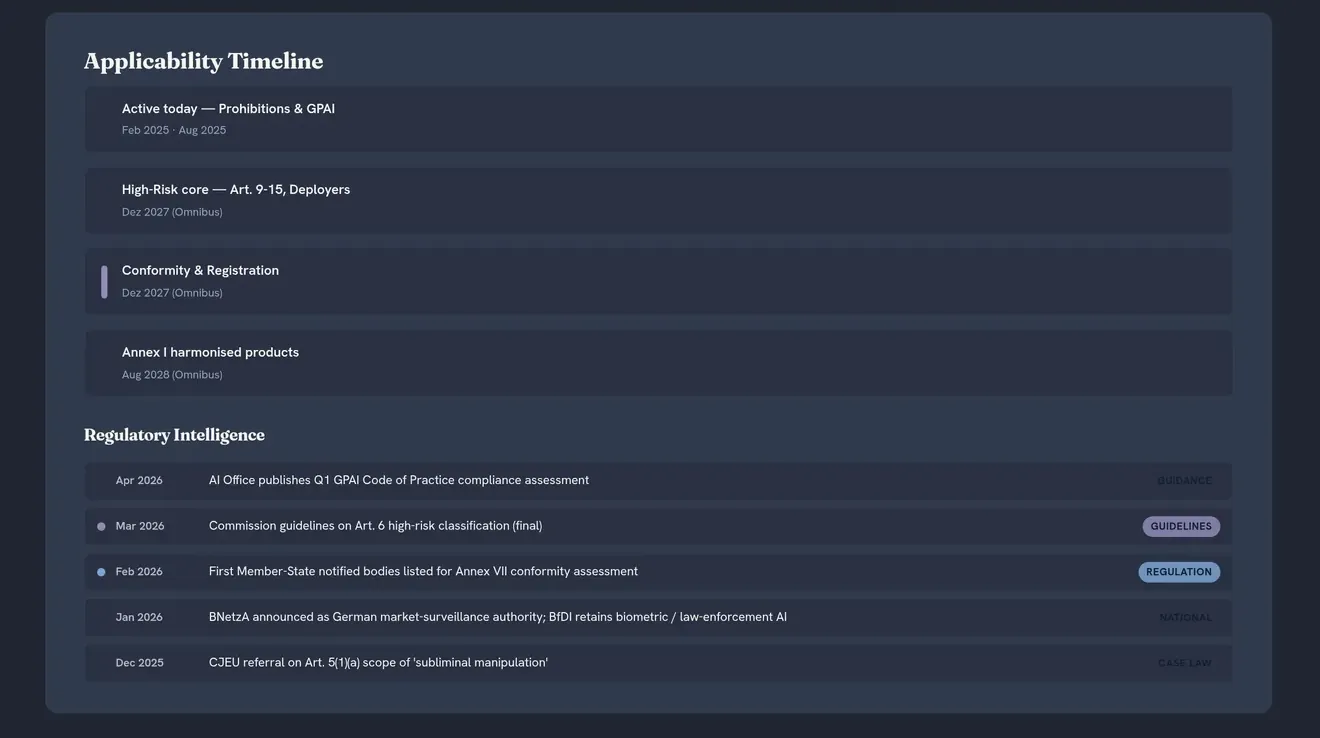
- Click ‘Roadmap’ in the ‘AI Act · L4’ sidebar. The Applicability Timeline shows four phases, ‘Regulatory Intelligence’ five dated items.
- Press ‘Stream’ at the top right (on a phone, the satellite-dish icon). It opens the Horizon Scanner; the ‘AI Act’ filter leaves three milestones.
Answers and portfolio stay in this browser's local storage, with no account (trust centre).
What the Roadmap shows, and on which legal basis
| Capability | Legal basis | Output |
|---|---|---|
| Applicability Timeline | Art. 5, 51 to 56 · Art. 9 to 15, 26 · Art. 43, 49 · Art. 6(1) | Four dated phases, ‘Feb 2025 · Aug 2025’ to ‘Aug 2028 (Omnibus)’, the same for every profile |
| Phase badge per obligation | Catalogue of 38 obligations, Art. 3(1) to Art. 111 | ‘Phase 1’ to ‘Phase 4’ on each card under ‘Obligations’ in the EU AI Act compliance cockpit |
| Horizon Scanner, AI Act filter | Art. 5 · GPAI obligations · high-risk systems | Three milestones — two ‘in force’, one counting down to 2 December 2027 — marked ‘Relevant to your profile’ by a fixed rule on your answers, no AI call |
| Regulatory Intelligence | None cited | Five static, tagged entries, December 2025 to April 2026 |
A US medical-software vendor, dated
A hypothetical US vendor with no EU establishment sells AI software that reads diagnostic images to EU hospitals; as a medical device needing notified-body assessment, it may be high-risk under Art. 6(1) and Annex I. Quick check: ‘Provider’, ‘Established outside the EU’, ‘Annex I EU product-safety product’. The portfolio shows one High-Risk system: ‘Hochrisiko-Produkt (Anhang I)’.
The Roadmap files such products under Phase 4, ‘Aug 2028 (Omnibus)’; the obligation cards do not: Art. 9 to 15 carry ‘Phase 2’, Art. 43 ‘Phase 3’, both ‘Dez 2027’. If the product is high-risk under Annex I, the statute's date is 2 August 2028.
The Horizon Scanner marks the high-risk milestone ‘Relevant to your profile’ and counts down to 2 December 2027; only its detail line gives 2 August 2028 for Annex I.
The banner ‘Authorised Representative required (Art. 22 AI Act)’ carries no date — a draft indication, not a finding. Art. 22 applies from 2 August 2028 for Annex I products and 2 December 2027 for Annex III systems, under Regulation (EU) 2026/1744; classification and Art. 111(2) decide whether this company must appoint.
The limits, stated plainly
- The Roadmap labels postponed dates ‘(Omnibus)’ without citing Regulation (EU) 2026/1744, in German (‘Dez 2027’); neither it nor the Horizon Scanner lists 2 August 2026, 2 December 2026 or 2 August 2027.
- Badges belong to the obligation, not the system, and can miss the statute: Annex I products get the same Phase 2 and 3 badges (‘Dez 2027’) as Annex III systems; Art. 50 carries Phase 2 though it has applied since 2 August 2026; the Art. 26 deployer card Phase 1 though Chapter III, Section 3 was postponed. The only ‘Phase 4’ card is Art. 95, voluntary codes.
- The Art. 22 / 54 representative card carries Phase 1, right for Art. 54 only; Art. 22 applies from 2 December 2027 (Annex III) and 2 August 2028 (Annex I), Regulation (EU) 2026/1744.
- Pre-amendment text remains: the Art. 4 card calls the amendment ‘not yet in force’; the legal-map corpus dates Art. 6(1) to 2 August 2027, which Home shows under ‘Insights’ as the next AI Act date. The Art. 111 card gives two cut-offs, 2 August 2026 and ‘Digital Omnibus 2 Dec 2027’; which applies is a legal question.
- Regulatory Intelligence cites no sources; one entry calls the Art. 6 guidelines final in March 2026 — verify before quoting. ‘Fetch live updates’ needs a local engine outside the browser edition.
Frequently asked questions
When does the EU AI Act take effect?
It already has, in part. Regulation (EU) 2024/1689 entered into force on 1 August 2024, but entry into force is not application: Art. 113 switches the rules on in steps, from the first prohibitions in February 2025 to Art. 50 transparency in August 2026. Regulation (EU) 2026/1744 set the high-risk dates: 2 December 2027 (Annex III) and 2 August 2028 (Annex I).
Has the EU AI Act been delayed?
In part. Regulation (EU) 2026/1744 — the Digital Omnibus on AI, in force since 27 July 2026 — postponed the high-risk rules of Chapter III, Sections 1 to 3: Annex III systems from 2 August 2026 to 2 December 2027, Annex I products from 2 August 2027 to 2 August 2028. The existing prohibitions, the GPAI rules and the general Art. 50 date did not move.
What applied on 2 August 2026, and what did not?
Art. 50 transparency applied, including disclosure of AI interaction, machine-readable marking of synthetic output (generative systems already on the market have until 2 December 2026) and labelling of deepfakes. The Commission's power to fine GPAI providers (Art. 101) began too. The Annex III high-risk rules did not: Regulation (EU) 2026/1744, in force six days earlier, moved them to 2 December 2027.
When do rules for AI in products such as medical devices apply?
From 2 August 2028, moved from 2 August 2027 by Regulation (EU) 2026/1744. Art. 6(1) covers AI systems that are products, or safety components of products, under the Annex I harmonisation legislation, where that legislation requires third-party conformity assessment — medical devices are one example. The suite's Roadmap shows it as phase 4; its cards and countdown say December 2027.
Do general-purpose AI models already on the market get more time?
Yes, within limits. Providers of GPAI models placed on the market — first made available in the Union — before 2 August 2025 have until 2 August 2027 to comply (Art. 111(3)), the Art. 54 mandate of non-EU providers included. Later models are bound from the day they are placed on the market.
What should a high-risk provider do before December 2027?
Treat the application date as the day the system must comply, not the day work starts: classification (Art. 6), Art. 9 to 15 with the Annex IV technical file, quality management (Art. 17) and conformity assessment (Art. 43) take lead time. A non-EU provider also needs an authorised representative (Art. 22). Both apply from 2 December 2027 (Annex III) and 2 August 2028 (Annex I), Regulation (EU) 2026/1744.
December 2027 or August 2028: which date governs your system?
The classification decides, not the EU AI Act timeline: Annex III uses point to 2 December 2027, AI in Annex I products to 2 August 2028. The suite indicates a tier (AI Act risk classification); it does not decide it. Whether a system already on the market stays outside under Art. 111(2), and from which cut-off, is a legal assessment for the law firm Theo Funk, under a separate mandate.
For non-EU providers of general-purpose AI models the Art. 54 mandate already applies, unless the open-source exception of Art. 54(6) covers the model; Regingada UG (haftungsbeschränkt) takes on that role under a written mandate — as representative, not legal adviser. For high-risk systems Art. 22 follows from 2 December 2027 (Annex III) and 2 August 2028 (Annex I), Regulation (EU) 2026/1744. Both roles: the authorised representative service.