
- Home
- Suite features
- Digital Services Act cockpit
Digital Services Act obligations, sorted by what your service is
The Regingada Compliance Suite’s cockpit for the EU Digital Services Act (DSA) gives each service a tier — mere conduit, caching, hosting, online platform, very large platform or search engine (VLOP, VLOSE) — and lists the Art. 4–49 provisions of the highest tier: a first pass at Digital Services Act compliance for non-EU companies, not a notice-and-action system.
- DSA · Art. 4–8, 11–17
- Art. 20–32 · platforms, marketplaces
- Notice-and-action queue · not built
- Report template · not built
What does Digital Services Act compliance mean for a company outside the EU?
For a company outside the EU, Digital Services Act compliance turns on each service’s tier: the DSA reaches intermediary services offered in the Union wherever the provider is established (Art. 2(1) DSA), and duties stack by tier. The DSA obligations by provider type:
- Every intermediary · Art. 11–15Contact points, a legal representative if not EU-established, terms, a transparency report.
- Hosting · Art. 16–18Notice and action, statements of reasons, reporting suspected offences against life or safety.
- Online platform · Art. 19–28Complaints, dispute settlement, trusted flaggers, interface design, ads, recommenders, minors.
- Marketplace · Art. 29–32Trader traceability, compliance by design, informing buyers.
- VLOP · VLOSE · Art. 33–43Only after Commission designation: systemic risk, audit, ad repository, data access.
That is why a flat DSA compliance checklist rarely fits. Unlike Section 230, the hosting exemption of Art. 6 DSA no longer shields a provider that has actual knowledge — or, for damages claims, awareness — of illegal content and fails to act expeditiously; the Chapter III due-diligence duties (Art. 11–48) apply regardless. The cockpit’s tiers and lists are orientation, not legal advice — drafts to review.
From the DSA card to a tiered duty list
Open /suite/#dsa, the DSA part of the suite’s compliance software, then:
- Confirm the legal notice. First visit only: what the suite is, and what it is not.
- Pick the DSA card. On the welcome screen, choose ‘DSA · Digital Services Act’.
- Answer the four quick-check steps. EU users and establishment; service type; the 45 million threshold (average monthly active EU recipients, Art. 33(1)); features such as uploads, ads, a recommender, a marketplace or minors. The answers seed a service named ‘Dienst (aus Onboarding)’ even in English. Cancelling returns you to Home; ‘DSA Twin’ in the left rail reopens it.
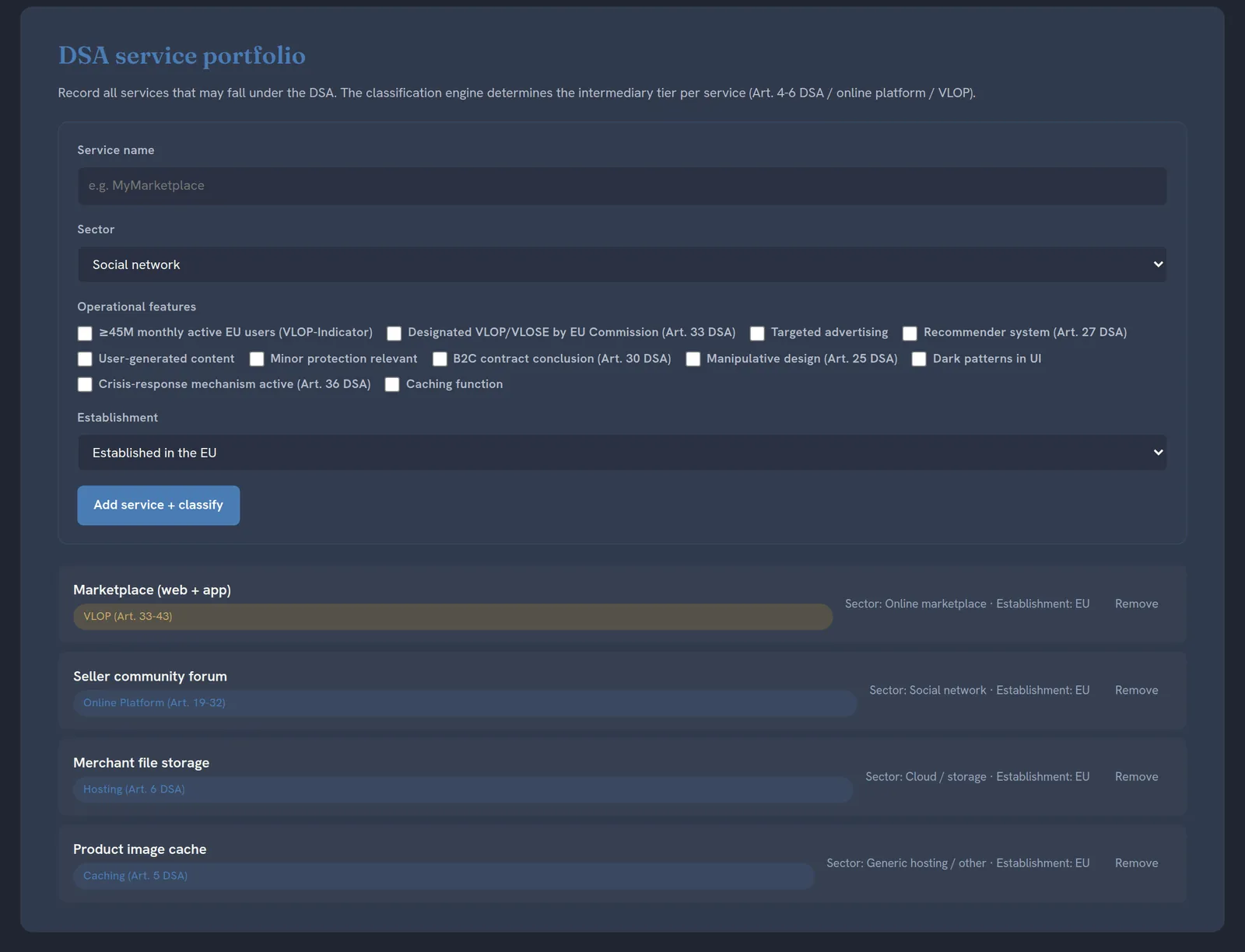
- Add further services. In the DSA sidebar, click ‘Service portfolio’: name, one of nine sectors, eleven operational features, establishment, ‘Add service + classify’.
- Read the duties. Click ‘Obligations’, ‘Transparency & Repository’, ‘Art. 13 EU Representation’ and ‘Roadmap’ in the sidebar, which scrolls to each; skip the ‘DSA Dashboard’ at the top (see the limits).
Answers and portfolio sit in this browser’s LocalStorage — no server-side copy, no login; see the Trust Center.
What the DSA cockpit shows, article by article
| Capability | Legal basis | Output |
|---|---|---|
| Service portfolio | Art. 3(g), 4–6, 19–33 DSA | Tier chip per service, with sector and establishment |
| Obligations (triggered) | Art. 4–49 DSA · § 12 DDG | At most 30 of 32 catalogued entries: article, effort and phase badges, legal summary, tasks |
| Transparency & Repository | Art. 15, 24, 39, 40, 42 DSA | Six cards in three tier groups, applicable or locked |
| VLOP Cockpit | Art. 33–38 DSA | At VLOP or VLOSE tier, Art. 34 and 35 sections (see systemic risk assessment); otherwise an explainer |
| Art. 13 EU Representation | Art. 13, 49 DSA · § 12 DDG | Designation duty, German supervisor, an e-mail link to the law firm — after ‘Established outside the EU’ |
| Roadmap | Art. 92, 93 DSA · DDG | 25 August 2023, 17 February 2024, 14 May 2024, ongoing CJEU case law |
Tiers are derived, not asked
Top down: a ticked designation gives VLOP or VLOSE; user content or the sectors social network, marketplace or app store give online platform (a shortcut: uploads alone do not make one, Art. 3(i) DSA); ‘Cloud / storage’ gives hosting; the rest is caching (temporary copies) or mere conduit (transmission only).
One governing tier
One list for the portfolio, though the DSA attaches duties per service: the highest tier plus every feature ticked on any service — ‘Targeted advertising’ adds Art. 26, a recommender Art. 27, minors Art. 28, B2C contracts Art. 30–32.
A US marketplace with a storage product
A hypothetical Delaware company — 180 staff, no EU establishment, some three million EU users a month — runs a consumer marketplace for independent makers, with advertising and a recommender, plus team file storage.
Quick check: EU users, established outside the EU, online platform, under 45 million, marketplace, advertising, recommender, uploads. The seeded service gets ‘Online Platform (Art. 19-32)’; the storage product, added under ‘Cloud / storage’, gets ‘Hosting (Art. 6 DSA)’.
‘Obligations’ then lists 23 entries: Art. 6–8, 11–17, 20–27, 30–32, 49 and § 12 DDG, which makes the Bundesnetzagentur the competent German authority — the main supervisor if the representative sits in Germany (Art. 56(6) DSA). Art. 28 stays out as minors were not ticked, though whether a marketplace is ‘accessible to minors’ (Art. 28(1)) is a judgement, not a tick box.
The list merges both services: Art. 16–17 bind both, Art. 20–27 and 30–32 only the marketplace, as team storage stays hosting (Art. 3(i) DSA). At 180 staff no size exemption applies; the designated-scale counterpart is the model case EuroMarktplatz.
The limits, stated plainly
- No workflow, no report. DSA notice and action (Art. 16), statements of reasons (Art. 17) and trader traceability (Art. 30) are task lists: no notice intake, moderation queue or trader verification, no Implementing Regulation (EU) 2024/2835 template, no submission to the DSA Transparency Database.
- Size not asked. The micro and small exemptions of Art. 15(2), 19 and 29 do not filter the list.
- Uploads read as a platform. ‘User uploads’ (quick check) or ‘User-generated content’ (form) makes any service an online platform; team storage without dissemination to the public stays hosting (Art. 3(i) and (k)).
- Hosting read narrowly. Only ‘Cloud / storage’ yields hosting. Media, crowdfunding, communications, undesignated search engines and generic hosting fall to mere conduit (or caching) without user content, as does a quick-check ‘Hosting service’ without uploads, ‘Cloud storage’ ticked or not — Art. 16 and 17 drop out.
- Designation inferred. ‘45 million or more’ in the quick check marks as designated any platform or search engine, or any service with uploads or a marketplace; only a Commission decision designates (Art. 33(4) DSA).
- Narrow triggers. Art. 13 needs ‘Established outside the EU’ in the quick check — not ‘Unsure’, nor the portfolio option labelled ‘Art. 13 DSA trigger’. In the form, Art. 26 hinges on ‘Targeted advertising’, though it covers every advertisement a platform presents (Art. 26(1)).
- Gaps. Art. 18 is not an entry; Art. 32 is tagged ‘Phase 3 · VLOP’, though undesignated marketplaces owe it too (Art. 29 aside). The ‘DSA Dashboard’ runs on an older data model: its score, fine, budget and peer figures are illustrative defaults, not drawn from your services.
Frequently asked questions
Does the EU Digital Services Act apply to US companies without an EU office?
Yes, where a company offers an intermediary service in the Union with a substantial connection — an EU establishment or factual criteria such as a significant number of recipients relative to a Member State’s population or activities targeted at Member States (Art. 2(1), 3(d) and (e) DSA). Without an establishment, Art. 13 adds a legal representative in a Member State.
What are the Digital Services Act requirements for a hosting provider?
DSA hosting provider obligations add three duties to Art. 11–15: notice and action (Art. 16), a statement of reasons for restrictions imposed because content is illegal or breaches the terms (Art. 17(1)), and informing law enforcement of suspected criminal offences that threaten life or safety (Art. 18).
Are small platforms exempt from DSA obligations?
Partly. Micro and small enterprises under Recommendation 2003/361/EC — fewer than 50 staff and at most €10 million turnover or balance-sheet total, partner and linked enterprises included — are exempt from the Art. 15 report (Art. 15(2) DSA), most DSA online platform obligations of Art. 20–28 (Art. 19) and Art. 30–32 (Art. 29), unless designated. Notice and action still applies.
Is there an official template for DSA transparency reports?
Yes: Commission Implementing Regulation (EU) 2024/2835 lays down harmonised templates for the DSA transparency report requirements of Art. 15, 24 and 42. The cockpit does not reproduce them; its ‘Transparency & Repository’ section only flags which reporting duty your tier reaches.
What are the penalties under the Digital Services Act?
Member States set them within caps: 6% of annual worldwide turnover for a breach, 1% for incorrect or misleading information, periodic penalties of 5% of average daily turnover (Art. 52(3) and (4) DSA). For designated very large platforms and search engines the Commission can fine up to 6% (Art. 74) and alone enforces Art. 33–43 (Art. 56(2)). The law firm compares fines across regimes.
Tier questions the classifier cannot settle
Three judgements shape which DSA duties apply, none a checkbox: a substantial connection to the Union (Art. 3(d) and (e) DSA); whether public dissemination is a minor, purely ancillary feature that, for objective and technical reasons, cannot be used without the main service (Art. 3(i)); and whether the company, with partner and linked enterprises, is micro or small.
The law firm Theo Funk can weigh them under a separate mandate and test your terms, notice flow and statements of reasons against Art. 14, 16 and 17.
Without an EU establishment, Art. 13 requires a legal representative in a Member State where you offer services. Regingada UG (haftungsbeschränkt) can be appointed under a representation contract, not legal advice: DSA legal representative under Article 13. The suite’s Art. 13 and ‘Mandate Packages’ mail links name the law firm for this role; the contract is with Regingada UG.